Speed limit in Morocco: rules, fines and radar zones
The speed limit in Morocco catches a lot of visitors off guard, mostly because it changes constantly and the signage isn’t always where you’d expect it. Knowing the numbers before you leave the rental lot saves you both money and an awkward roadside conversation.
Speed limit in Morocco at a glance
- Motorways: 120 km/h
- Rural roads outside towns: 100 km/h
- Towns and villages: 60 km/h, and sometimes 40 km/h near schools, markets or sharp bends
Keep these figures in mind: the speed limit in Morocco is enforced with fixed cameras, mobile radar and handheld radar at checkpoints.
Speed limit in Morocco: the basic numbers
On motorways (the toll roads, marked with green signs), the limit is 120 km/h. On regular rural roads outside towns, it’s 100 km/h. Inside towns and villages, it drops to 60 km/h, and in a lot of places it drops again to 40 km/h near schools, markets, or sharp bends, sometimes with almost no warning. The town-entrance sign itself (a white rectangle with the village name) is your cue that the limit just changed, even if you don’t see a separate speed sign right away.
What trips people up is how fast these zones switch. You can be doing a comfortable 100 km/h on an open stretch, round a bend, and suddenly you’re entering a village at 100 km/h when the limit is 60. Radar vans and fixed cameras are placed exactly at these transition points more often than not.
Where the radars actually are
Morocco uses a mix of fixed speed cameras, mobile radar units parked on the roadside, and handheld radar at checkpoints. They’re common on the approach to towns along the Marrakech-Agadir and Marrakech-Casablanca corridors, and especially dense around Rabat and Casablanca where enforcement is strict. Waze and Google Maps both pick up a decent share of fixed cameras from community reports, so it’s worth having one running, though neither catches every mobile unit.
Our police checkpoints guide covers what else officers typically check beyond speed, since a radar stop often turns into a quick document check too.
What happens if you get flagged
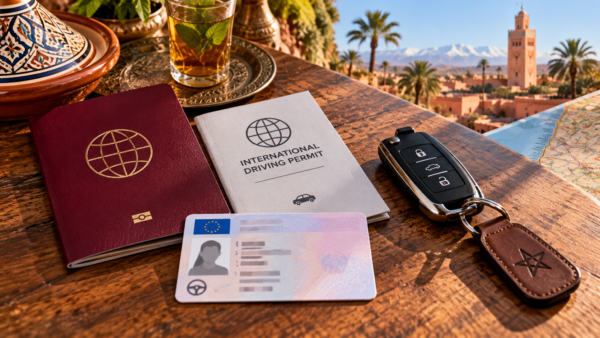
If an officer waves you over for speeding, you’ll usually get asked for your license and the car’s registration or rental contract. Fines are generally payable on the spot in cash, and they scale with how far over the limit you were, roughly in the range of 200 to 700 MAD for a first offense at moderate speeds, though this isn’t fixed and officers have some discretion. Always ask for a receipt (un recu or une quittance). A legitimate fine comes with paperwork; if nobody offers one, that’s worth noting.
Rental companies, us included, hold you responsible for any fine issued while you had the car, so this isn’t something that gets absorbed into the rental cost. It’s your fine, your responsibility, same as it would be at home.
Driving style that actually works here
Morocco’s limits aren’t suggestions, but local traffic flow is often a bit faster than the posted number on open highway stretches. That doesn’t mean you should match it. Rental cars get flagged more easily (foreign-looking plates or rental company stickers draw attention), and insurance complications from an accident while speeding are a real headache you don’t want on a two-week trip. Keep 10 to 15 km/h of buffer under the limit on anything you’re not 100% sure about, and slow down hard the moment you see a town sign, even if the road still looks empty.
Night driving changes the math too. Pedestrians, cyclists without lights, and the occasional donkey cart are far more common on rural roads than most tourists expect, and your reaction time at 100 km/h in the dark is a lot worse than it feels.
Before your trip
For general background on speed regulation, the speed limit Wikipedia page gives useful international context on how these systems typically work. For the full picture of Moroccan road rules beyond speed, our complete guide to driving in Morocco and toll roads guide are worth a read, and our fuel prices guide helps you budget the motorway tolls alongside fuel.
Book your car in Marrakech or browse our full Morocco car rental guide, then head to the shop to reserve your dates. Ask us for a dash-cam equipped vehicle if you want extra peace of mind on longer drives.