
Morocco Road Trip Routes: 7 Epic Drives from Coast to Desert (2026 Guide)
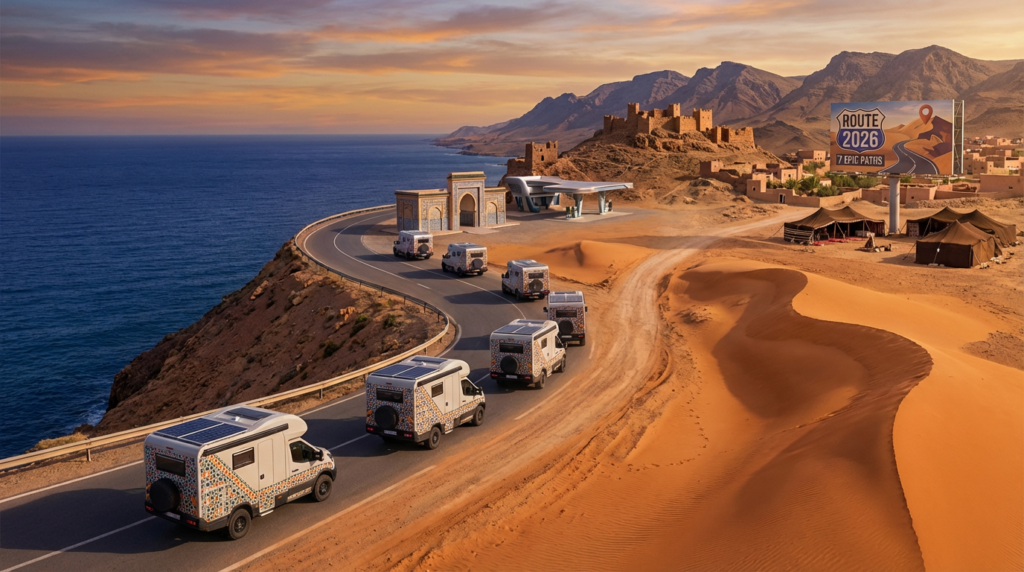
Morocco offers seven unforgettable road trip routes showcasing diverse landscapes from Atlantic beaches to Sahara dunes. The Grand Tour (10-14 days, 2,400 km) connects imperial cities, mountains, and desert. The Atlas Adventure (5-7 days, 850 km) explores Berber villages and mountain passes. The Coastal Escape (7-9 days, 1,300 km) follows Atlantic shores from Tangier to Agadir. The Desert Discovery (7-10 days, 1,800 km) reaches Sahara camps and ancient kasbahs. The Northern Circuit (5-7 days, 900 km) visits Chefchaouen and Rif Mountains. The Southern Oasis Trail (8-10 days, 1,600 km) explores palm groves and valleys. The Imperial Cities Loop (4-5 days, 750 km) tours Morocco’s historic capitals. Each route includes detailed itineraries, accommodation suggestions, must-see stops, driving times, road conditions, and seasonal considerations for 2026.
Introduction: Why Morocco Is the Ultimate Road Trip Destination
Morocco stands as one of the world’s most rewarding road trip destinations, offering extraordinary diversity compressed into a relatively compact country. Within a single week, you can drive from snow-capped Atlas Mountain peaks through lush cedar forests, across vast desert dunes where Berber nomads tend camels, and down to sun-drenched Atlantic beaches where fishing villages have operated for centuries. Few countries pack such dramatic landscape variety, cultural richness, and accessible infrastructure into distances manageable without marathon driving sessions.
Morocco’s modernized road network makes independent exploration feasible and enjoyable. Over 1,800 kilometers of smooth toll highways connect major cities, while scenic national roads wind through valleys, over mountain passes, and along coastlines with spectacular views at every turn. Whether you’re seeking adventure, culture, relaxation, or photography opportunities, Morocco’s roads deliver experiences that organized tours simply cannot match—the freedom to stop at unmarked kasbahs, share mint tea with Berber families, chase perfect sunset light over dunes, or extend your stay in villages that capture your imagination.
This comprehensive guide presents seven epic road trip routes covering Morocco’s most spectacular regions. Each itinerary includes detailed day-by-day breakdowns, driving distances and times, accommodation recommendations across all budgets, must-see stops, hidden gems, seasonal considerations, and practical tips for navigation and road conditions. Whether you have four days or two weeks, prefer luxury riads or budget guesthouses, seek adrenaline or tranquility, one of these routes will match your Morocco road trip dreams.
Route 1: The Grand Tour – Morocco’s Ultimate Journey (10-14 Days, 2,400 km)
Overview: The definitive Morocco road trip combining imperial cities, Atlas Mountains, Sahara Desert, ancient kasbahs, and coastal beauty. This comprehensive circuit showcases Morocco’s greatest highlights in a logical loop starting and ending in Casablanca or Marrakech.
Best For: First-time visitors wanting complete Morocco experience, photographers, culture enthusiasts, adventure seekers with 10-14 days available
Vehicle Recommendation: Compact SUV or 4×4 for desert sections and mountain passes
Best Season: March-May and September-November for optimal weather across all regions
Detailed Itinerary:
Day 1: Casablanca to Rabat (90 km, 1 hour)
Start your journey in Casablanca, Morocco’s economic capital. Visit the magnificent Hassan II Mosque overlooking the Atlantic (one of few mosques non-Muslims can enter, guided tours available). Drive north on the A3 toll highway to Rabat, Morocco’s political capital and a UNESCO World Heritage site.
Rabat Highlights:
- Kasbah of the Udayas: Historic fortified neighborhood with blue and white houses, Andalusian gardens, ocean views
- Hassan Tower & Mohammed V Mausoleum: Unfinished 12th-century minaret and stunning royal mausoleum
- Chellah Necropolis: Ancient Roman and medieval Islamic ruins with storks nesting atop columns
Accommodation: Riad Kalaa or Dar Shaan (mid-range riads), La Tour Hassan Palace (luxury), Riad Zyo (budget-friendly)
Driving Notes: Excellent toll highway, minimal challenges, easy introduction to Morocco driving
Day 2: Rabat to Chefchaouen (250 km, 3.5 hours)
Head north through rolling agricultural countryside, bypassing Tangier, toward the Rif Mountains. The landscape gradually shifts from coastal plains to dramatic mountain scenery as you approach Chefchaouen.
Chefchaouen Experience:
Morocco’s famous “Blue Pearl” captivates with its blue-washed medina buildings set against mountain backdrop. Spend the afternoon and evening photographing blue doorways, browsing artisan shops, and hiking to Spanish Mosque for sunset panoramas.
Must Do:
- Get lost in the blue medina lanes (especially photogenic in morning/evening light)
- Ras El Maa waterfall and river (locals gather, restaurants with terraces)
- Sunset hike to Spanish Mosque (30 minutes uphill, spectacular views)
Accommodation: Lina Ryad & Spa (boutique luxury), Dar Echchaouen (mid-range charm), Pension Castellana (budget hostel)
Driving Notes: Mountain roads with curves and elevation gain; drive carefully but not technically difficult
Day 3: Chefchaouen to Fes (200 km, 4 hours)
Depart the blue city southward through the Rif Mountains, descending toward Fes. Consider stopping in Ouazzane, a traditional Moroccan town rarely visited by tourists, for authentic street food lunch.
Fes Afternoon:
Arrive in Fes, Morocco’s spiritual and cultural heart with the world’s largest car-free medieval medina. Check into accommodation, rest, then explore Fes el-Bali (old city) perimeter in late afternoon.
Accommodation: Riad Fes (luxury palace hotel), Dar Seffarine (mid-range authentic riad), Dar Ahl Tadla (budget-friendly guesthouse)
Evening Tip: Enjoy dinner at Café Clock (contemporary Moroccan cuisine, rooftop terrace) or traditional restaurant in your riad
Driving Notes: Mix of mountain and highway driving; straightforward navigation
Day 4: Fes Full Day (No Driving)
Park your car (free street parking outside medina or guarded lots €3-€5/day) and dedicate a full day to exploring Fes’s labyrinthine medina—one of Morocco’s most intense cultural experiences.
Fes Must-See:
- Bou Inania Madrasa: Stunning 14th-century Quranic school with intricate tilework
- Chouara Tannery: Ancient leather dyeing pits (visit morning for best light, expect pushy guides)
- Al-Qarawiyyin Mosque & University: World’s oldest continually operating university (founded 859 AD), limited exterior viewing
- Nejjarine Museum of Wooden Arts: Beautiful funduq (caravanserai) showcasing traditional crafts
- Bab Boujloud (Blue Gate): Iconic medina entrance perfect for photos
Tip: Hire an official guide for morning (€20-€30, 3-4 hours) to navigate the overwhelming medina, then explore independently in afternoon.
Day 5: Fes to Merzouga via Midelt & Ziz Valley (470 km, 7-8 hours)
The longest driving day but one of Morocco’s most spectacular journeys. Depart early (7-8 AM) heading south through Middle Atlas Mountains, across high plateaus, through dramatic Ziz Valley gorges, and into the Sahara’s edge.
Route Highlights:
- Ifrane (1 hour from Fes): “Little Switzerland” of Morocco—European-style alpine town, photo stop
- Cedar Forests near Azrou: Habitat for Barbary macaque monkeys (stop for photos, feed monkeys)
- Midelt (3 hours from Fes): Apple-growing mountain town, lunch stop with Atlas views
- Ziz Valley (after Midelt): Dramatic gorge with lush palm groves, ancient kasbahs, photo opportunities
- Erfoud: Date capital of Morocco, gateway to desert
Merzouga Arrival (Late Afternoon/Evening):
Reach Merzouga by sunset for magical light over Erg Chebbi dunes. Many hotels arrange desert camp overnight experiences—consider upgrading to luxury desert camp (€80-€150 per person) including camel trek, dinner, sunrise, and stargazing.
Accommodation: Luxury desert camps (Sahara Sky Luxury Camp, Merzouga Desert Camps), mid-range desert hotels (Kasbah Mohayut, Riad Madu), budget auberges
Driving Notes: Long day but excellent paved roads throughout; Morocco’s N13 and N10 routes are well-maintained with spectacular scenery
Day 6: Merzouga Desert Experience & Drive to Todra Gorge (200 km, 3 hours)
Wake early for sunrise over dunes (5:30-6:30 AM depending on season). After breakfast, optional activities include:
- 4×4 desert tours to nomad families and fossil sites
- Sandboarding on dunes
- Quad biking adventures
- Village visits
Mid-Morning Departure to Todra Gorge:
Drive west through desert landscape, passing through Rissani (ancient capital, authentic souk on Sunday/Tuesday/Thursday), Erfoud, and Tinejdad before reaching Todra Gorge.
Todra Gorge Experience:
Walk through the dramatic 300-meter-high canyon with walls just 10-20 meters apart in narrowest sections. Rock climbers scale the walls; photographers chase light; travelers simply marvel at nature’s power. Short walk (20-30 minutes up canyon) offers spectacular views.
Accommodation: Kasbah Tizimi (mid-range), Dar Ayour (budget guesthouse), Hotel Yasmina (simple but well-located)
Driving Notes: Excellent paved roads; straightforward navigation
Day 7: Todra Gorge to Dades Valley & Ait Benhaddou (280 km, 5 hours with stops)
One of Morocco’s most scenic driving days through the “Road of 1000 Kasbahs” via Dades Valley and Rose Valley, ending at Morocco’s most famous kasbah.
Route Highlights:
- Dades Gorge: Winding road through red rock canyon (drive 30 km into gorge for best views)
- Valley of Roses (Kelaat M’Gouna): Rose cultivation region, rose products (May rose festival)
- Skoura: Palm oasis with ancient kasbahs, Kasbah Amridil museum
- Ouarzazate: “Hollywood of Morocco,” film studios, Kasbah Taourirt
Ait Benhaddou Evening:
Arrive late afternoon at UNESCO World Heritage Ait Benhaddou, Morocco’s most photographed kasbah. Cross the river (usually shallow, stepping stones available) and climb through the ancient fortified village for sunset panoramas. Recognize filming locations from Game of Thrones, Gladiator, Lawrence of Arabia.
Accommodation: Kasbah Valentine (facing Ait Benhaddou, mid-range), Riad Maktoub (luxury), Chez Brahim (budget auberge)
Driving Notes: Mix of excellent highways and winding mountain roads; allow extra time for photo stops
Day 8: Ait Benhaddou to Marrakech via Tizi n’Tichka Pass (190 km, 4 hours)
Cross the High Atlas Mountains via Morocco’s highest major pass, the spectacular Tizi n’Tichka (2,260 meters). The highway winds through dramatic mountain scenery with sweeping valley views, Berber villages clinging to slopes, and roadside stalls selling fossils and minerals.
Route Highlights:
- Tizi n’Tichka summit: Photo stop, panoramic views, tourist stalls
- Telouet Kasbah (30 km detour): Former palace of Glaoui family, crumbling but magnificent
- Atlas Mountain views: Snow-capped peaks (winter/spring), terraced agriculture, Berber architecture
Marrakech Arrival (Afternoon):
Descend into Marrakech, Morocco’s tourist capital. Navigate to your riad (many are in car-free medina—confirm parking arrangements). Afternoon exploring Jemaa el-Fnaa square’s snake charmers, storytellers, orange juice stalls, and evening food market chaos.
Accommodation: La Mamounia or Royal Mansour (luxury icons), Riad Yasmine (mid-range charm), Equity Point Marrakech (budget hostel)
Evening: Dinner at rooftop restaurant overlooking Jemaa el-Fnaa (Nomad, Le Salama) or traditional Moroccan feast at your riad
Driving Notes: Mountain pass with curves, elevation changes, and occasional tour buses; drive carefully but well-maintained road
Day 9: Marrakech Full Day (No Driving)
Park your car and explore Marrakech’s treasures on foot or via petit taxi. For comprehensive Marrakech guidance, visit our Car Rental in Marrakech page.
Marrakech Must-See:
- Jemaa el-Fnaa: Heart of Marrakech, chaotic and fascinating, different atmosphere morning vs. evening
- Bahia Palace: 19th-century palace showcasing Moroccan craftsmanship
- Saadian Tombs: Stunning 16th-century royal necropolis, intricate decorations
- Koutoubia Mosque: Iconic 12th-century minaret, Marrakech’s landmark
- Majorelle Garden: Yves Saint Laurent’s cobalt blue garden oasis, peaceful escape from medina chaos
- Souks: Labyrinthine markets selling everything imaginable, haggling expected
Optional: Day trip to Essaouira (175 km, 2.5 hours) or Ourika Valley (65 km, 1.5 hours)
Day 10: Marrakech to Essaouira (175 km, 2.5 hours)
Drive west through argan tree groves toward the Atlantic coast and Essaouira, Morocco’s laid-back coastal gem known for constant winds (windsurfing/kitesurfing capital), artistic vibe, and fresh seafood.
Essaouira Experience:
Wander the blue and white medina (smaller, less intense than Marrakech or Fes), walk the ramparts overlooking Atlantic waves, watch fishing boats in the harbor, browse art galleries and craft shops, enjoy fresh grilled fish at harbor stalls.
Accommodation: Riad Watier or Villa Maroc (boutique luxury), Riad Mimouna (mid-range), Atlantic Hostel (budget)
Driving Notes: Excellent paved road through argan country; easy drive
Days 11-12: Essaouira to Casablanca via Coastal Route (Options)
Direct Route (380 km, 4.5 hours): Take N1 highway through Safi and El Jadida back to Casablanca. For Casablanca car rental options, see our Car Rental Casablanca page.
Scenic Coastal Option (Add 1-2 Days):
- Day 11: Essaouira to Oualidia (180 km, 2.5 hours) – famous lagoon oysters, beach relaxation
- Day 12: Oualidia to Casablanca (200 km, 2.5 hours) via El Jadida (Portuguese fortified city, UNESCO site)
Total Route: 2,400 km over 10-14 days depending on pace and optional extensions
Budget Estimate (Per Person, Couple Sharing):
- Budget: €800-€1,100 (economy car, guesthouses, local restaurants)
- Mid-Range: €1,400-€1,900 (compact SUV, riads, mix of restaurants)
- Luxury: €2,800-€4,500+ (SUV, luxury hotels/riads, fine dining)
For detailed cost breakdowns, see our Car Rental Morocco Cost Guide.
Route 2: The Atlas Adventure – Mountains & Berber Villages (5-7 Days, 850 km)
Overview: Focused exploration of Morocco’s magnificent Atlas Mountains, from valleys to peaks, Berber culture to mountain passes, waterfalls to ancient kasbahs. Perfect for nature lovers, hikers, and photographers seeking Morocco’s mountain majesty.
Best For: Active travelers, mountain enthusiasts, cultural explorers, those seeking cooler weather
Vehicle Recommendation: SUV or 4×4 for unpaved village access roads
Best Season: April-June and September-October (July-August very hot in valleys; December-March snow closes high passes)
Detailed Itinerary:
Day 1: Marrakech to Imlil Valley (65 km, 2 hours)
Depart Marrakech south into the High Atlas foothills via Tahanaoute and Asni. The road climbs through increasingly dramatic mountain scenery toward Imlil, Morocco’s trekking hub at the base of Jebel Toubkal (4,167m), North Africa’s highest peak.
Imlil Activities:
- Base for Toubkal treks (summit requires 2 days minimum)
- Day hikes to Berber villages (Armed, Ait Souka)
- Mule rides to mountain waterfalls
- Village guesthouse stays with Berber families
Accommodation: Kasbah du Toubkal (luxury mountain lodge), Dar Imlil (mid-range), Atlas Mazik (budget guesthouse)
Note: Imlil village is car-accessible but narrow road; larger vehicles may find parking challenging
Day 2: Imlil to Ourika Valley via Oukaimeden (Optional Ski Resort Visit)
Cross mountain roads (some unpaved sections possible) toward Ourika Valley, famous for seven waterfalls, riverside restaurants, and pottery workshops.
Optional Detour: Oukaimeden ski resort (winter only, December-March) at 2,600m elevation
Ourika Valley Highlights:
- Setti Fatma village: Base for waterfall hikes (2-hour round trip to top waterfall)
- Riverside lunch: Numerous restaurants with terraces over streams
- Berber women’s argan oil cooperatives
Accommodation: Auberge Le Maquis (mid-range mountain hotel), local guesthouses in Setti Fatma (budget)
Driving Notes: Mountain roads with some unpaved sections; SUV recommended
Day 3: Ourika Valley to Ait Benhaddou via Tizi n’Tichka Pass (220 km, 4.5 hours)
Cross the High Atlas via the spectacular Tizi n’Tichka pass (detailed in Grand Tour above), descending into semi-arid landscapes toward Ait Benhaddou.
Afternoon: Explore Ait Benhaddou kasbah, one of Morocco’s most photographed sites
Accommodation: Options listed in Grand Tour section above
Day 4: Ait Benhaddou to Dades Valley via Skoura & Roses Valley (200 km, 4 hours with stops)
Drive the scenic “Road of 1000 Kasbahs” through palm oases, rose cultivation valleys, and ancient fortified villages.
Highlights:
- Skoura Palmery: Visit Kasbah Amridil museum
- Valley of Roses: Rose products, distilleries (spectacular in May during rose harvest festival)
- Dades Gorge: Drive into gorge, hike to rock formations
Accommodation: Auberge Chez Pierre (Dades Gorge, mountain views), Hotel Xaluca Dades (mid-range comfort)
Day 5: Dades Valley to Todra Gorge & Tinghir (55 km, 1.5 hours)
Short drive to dramatic Todra Gorge for morning light photography and canyon hiking.
Afternoon Options:
- Explore Tinghir town and palmery
- 4×4 excursion to remote Berber villages
- Rock climbing in Todra Gorge (guides available)
Accommodation: Hotels listed in Grand Tour Todra section
Day 6: Todra Gorge to Midelt via Imilchil (Optional Extended Mountain Route)
Standard Route (230 km, 4 hours): Direct via main road to Midelt
Adventure Route (Add day, 4×4 essential): Via Imilchil—remote Berber village famous for annual “Marriage Festival” (September), stunning mountain scenery, rough roads
Midelt: Apple-growing town between Middle and High Atlas ranges
Accommodation: Kasbah Asmaa (mid-range), Hotel Atlas Asmaa (budget)
Day 7: Midelt to Marrakech via Azrou & Ifrane (450 km, 6 hours)
Return through Middle Atlas cedar forests, stopping to photograph Barbary macaque monkeys near Azrou and European-style Ifrane before highway descent to Marrakech.
Total Route: 850 km over 5-7 days depending on pace and optional detours
Budget Estimate (Per Person, Couple Sharing):
- Budget: €450-€650 (economy car/SUV, guesthouses, simple meals)
- Mid-Range: €800-€1,200 (SUV, mountain lodges/kasbahs, good restaurants)
- Luxury: €1,600-€2,500 (4×4, luxury mountain retreats, premium experiences)
Route 3: The Coastal Escape – Atlantic Shores & Beach Towns (7-9 Days, 1,300 km)
Overview: Morocco’s Atlantic coastline offers dramatic cliffs, fishing villages, surfing beaches, Portuguese fortifications, and fresh seafood. This relaxed route follows the coast from northern Tangier to southern Agadir, perfect for beach lovers and surf enthusiasts.
Best For: Beach seekers, surfers, seafood lovers, relaxed travelers, families
Vehicle Recommendation: Any vehicle; economy cars suitable for excellent coastal highways
Best Season: Year-round (winter can be rainy/windy but mild; summer hot but coastal breezes moderate temperatures)
Detailed Itinerary:
Day 1: Tangier to Asilah (45 km, 45 minutes)
Begin in Tangier, Morocco’s gateway city with Mediterranean and Atlantic coastlines meeting at Cap Spartel. Drive south along the coast to charming Asilah, famous for its white and blue medina walls decorated with murals. For Tangier car rental information, visit our Car Rental in Tangier page.
Asilah Highlights:
- Medina walking: Art galleries, murals, relaxed atmosphere
- Beach relaxation: Long sandy beach north of medina
- Portuguese fortifications: 15th-century ramparts overlooking ocean
Accommodation: Dar Azaila (boutique riad), Hotel Zelis (mid-range beachfront), Casa Perleta (budget)
Day 2: Asilah to Rabat (210 km, 2.5 hours)
Continue south via Larache (optional lunch stop in this authentic fishing town rarely visited by tourists) to Rabat, Morocco’s capital blending history with modern sophistication. For Rabat car rental options, see our Car Rental Rabat page.
Rabat: Covered in Grand Tour section—stay 1-2 nights
Accommodation: Riad Kalaa, Dar Shaan (mid-range), La Tour Hassan Palace (luxury)
Day 3: Rabat to Casablanca via Temara Beach (90 km, 1.5 hours)
Short drive south with optional beach stops along the way. Spend afternoon/evening in Casablanca visiting Hassan II Mosque and corniche waterfront.
Casablanca: Morocco’s economic capital, modern and bustling
Accommodation: Four Seasons Casablanca (luxury), Kenzi Tower Hotel (mid-range business hotel), Ibis Casa Voyageurs (budget chain)
Day 4: Casablanca to El Jadida (100 km, 1.5 hours)
Drive south to El Jadida, Portuguese fortified city dating to early 16th century, now UNESCO World Heritage site with impressive bastions and underground cistern.
El Jadida Experience:
- Portuguese City (Cite Portugaise): Wander fortified medina
- Portuguese Cistern: Atmospheric underground chamber with reflective water
- Beach relaxation: Wide sandy beach popular with Moroccan families
Accommodation: Mazagan Beach Resort (luxury all-inclusive), L’Iglesia El Jadida (converted church hotel, mid-range), budget hotels in town
Day 5: El Jadida to Oualidia (85 km, 1.5 hours)
Head south to Oualidia, Morocco’s oyster capital famous for its protected lagoon, excellent seafood restaurants, and tranquil beach atmosphere.
Oualidia Highlights:
- Fresh oysters at lagoon-side restaurants (La Sultana’s restaurant, L’Araignée Gourmande)
- Lagoon kayaking/paddleboarding
- Beach walks and birdwatching
- Surfing at ocean beach south of lagoon
Accommodation: La Sultana Oualidia (luxury boutique), Hippocampe Hotel (mid-range), budget guesthouses in village
Day 6: Oualidia to Essaouira (180 km, 2.5 hours)
Continue south through Safi (major fishing port, optional lunch stop) to Essaouira, Morocco’s bohemian coastal jewel.
Essaouira: Covered in Grand Tour—stay 2-3 nights to fully enjoy relaxed atmosphere
Activities:
- Windsurfing/kitesurfing lessons (constant winds create ideal conditions)
- Medina exploration and art gallery browsing
- Fresh seafood at harbor grills
- Day trip to Diabat beach and Jimi Hendrix’s former hangout
Accommodation: Riad Watier, Villa Maroc (boutique luxury), Riad Mimouna (mid-range), Atlantic Hostel (budget)
Day 7-8: Essaouira to Agadir via Taghazout (180 km, 2.5 hours)
Drive south along spectacular coastal road through argan groves toward Agadir, Morocco’s premier beach resort city, with optional stop in Taghazout, surfing village turned bohemian retreat. For Agadir car rental options, visit our Car Rental Agadir page.
Taghazout (Optional 1-2 Nights):
- Surf central: Numerous breaks for all levels (Anchor Point, Killer Point, Hash Point)
- Surf camps and yoga retreats
- Budget-friendly guesthouses and beachfront cafes
- Sunset watching at Paradise Valley (30 minutes inland)
Agadir (1-2 Nights):
- Modern beach resort city rebuilt after 1960 earthquake
- 10 km of sandy beach perfect for swimming, sunbathing
- Marina promenade with restaurants
- Agadir Oufella Kasbah ruins (panoramic city views)
- Day trips: Paradise Valley (natural pools), Tiznit (silver jewelry), Anti-Atlas Mountains
Accommodation Taghazout: Paradis Plage Resort (luxury surf retreat), Dar Josephine (mid-range), Auberge Sunset Taghazout (budget surf hostel)
Accommodation Agadir: Sofitel Agadir Thalassa (luxury beachfront), Atlantic Palace Resort (mid-range), Hotel Sindibad (budget)
Day 9: Return Options
- Agadir to Marrakech: 250 km, 3 hours via N8 through High Atlas (Tizi n’Test pass) or 255 km, 3.5 hours via autoroute and Tizi n’Tichka
- Agadir to Casablanca: 490 km, 5.5 hours via coastal A7/N1 highways
Total Route: 1,300 km over 7-9 days depending on beach relaxation time
Budget Estimate (Per Person, Couple Sharing):
- Budget: €600-€900 (economy car, guesthouses, local seafood restaurants)
- Mid-Range: €1,100-€1,600 (compact car, beach hotels/riads, quality seafood dining)
- Luxury: €2,400-€3,800 (premium car, luxury beach resorts, fine dining)
Route 4: The Desert Discovery – Sahara, Kasbahs & Oases (7-10 Days, 1,800 km)
Overview: Focus on Morocco’s desert regions, ancient kasbahs, dramatic valleys, and Sahara dunes. This route emphasizes southern Morocco’s arid beauty, Berber culture, and desert adventures.
Best For: Desert enthusiasts, adventure travelers, photographers, culture seekers
Vehicle Recommendation: SUV or 4×4 essential for desert access and unpaved sections
Best Season: October-April (May-September extremely hot in desert, 40-48°C common)
Detailed Itinerary:
Day 1: Marrakech to Ouarzazate (205 km, 4 hours via Tizi n’Tichka)
Cross High Atlas Mountains via Tizi n’Tichka pass, descending into semi-arid Pre-Sahara landscapes.
Ouarzazate Afternoon:
- Film studios tour (Atlas Studios, 1 hour)
- Kasbah Taourirt visit (former Glaoui family palace)
- Sunset at Fint Oasis (15 km north of Ouarzazate)
Accommodation: Ksar Ighnda (luxury kasbah hotel), Le Temple Des Arts (mid-range boutique), Hotel Amlal (budget)
Day 2: Ouarzazate to Merzouga via Dades & Todra Gorges (350 km, 6 hours)
Long but spectacular day driving the “Road of 1000 Kasbahs” through gorges and palm valleys toward Sahara’s edge (detailed in Grand Tour).
Route: Ouarzazate → Skoura → Dades Gorge → Todra Gorge → Erfoud → Merzouga
Merzouga Evening: Arrive for sunset over Erg Chebbi dunes, luxury desert camp overnight
Accommodation: Luxury desert camps (Sahara Sky, Merzouga Luxury Desert Camps), Kasbah Mohayut (mid-range)
Day 3: Merzouga Desert Experience (Full Day)
Dedicate entire day to desert activities:
- Sunrise camel trek (wake 5:30 AM)
- 4×4 desert tour to nomad families and Khamlia village (Gnawa music)
- Sandboarding on dunes
- Quad biking adventures
- Visit to fossil workshops in Erfoud
Evening: Second night in desert camp or return to Merzouga hotel
Day 4: Merzouga to Zagora via N12 Desert Road (295 km, 4.5 hours)
Drive south then west across dramatic desert landscapes via Tazzarine and Alnif, connecting Morocco’s two desert gateway towns.
Zagora Experience:
- Gateway to Draa Valley, Morocco’s longest river valley
- Sign reading “Timbuktu 52 days by camel” (famous photo spot)
- Smaller dunes than Merzouga but less touristy
- Tamegroute: Ancient Islamic library, underground kasbah, green pottery workshops
Accommodation: Riad Lamane (Tamegroute luxury), Kasbah Azul (mid-range), basic hotels in Zagora town
Driving Notes: Remote route with excellent paved road, minimal services between towns, fuel stations in Tazzarine and Alnif
Day 5: Zagora to Agdz via Draa Valley (95 km, 2 hours)
Drive through spectacular Draa Valley palmery—33 km of continuous palm groves, ancient kasbahs, and Berber villages. This is Morocco’s most extensive oasis system.
Highlights:
- Tamegroute Islamic library (11th century, ancient manuscripts)
- Palm grove walks in Amezrou
- Kasbah visits in numerous villages
- Lunch overlooking palmery
Agdz: Small town at Draa Valley’s northern end, base for exploring kasbahs
Accommodation: Kasbah Azul (mid-range comfort), Chez Yacob (budget kasbah guesthouse)
Day 6: Agdz to Ait Benhaddou via Ouarzazate (180 km, 2.5 hours)
Return through Ouarzazate to Ait Benhaddou for sunset photography and overnight stay in restored kasbah guesthouse.
Afternoon: Explore Ait Benhaddou at leisure, climb to top for panoramic views
Accommodation: Kasbah Valentine (facing Ait Benhaddou), Riad Maktoub (luxury), Chez Brahim (budget)
Day 7: Ait Benhaddou to Taroudant via Tizi n’Test Pass (280 km, 5 hours)
Cross the High Atlas via the dramatic, less-traveled Tizi n’Test pass (2,092m)—narrower and more spectacular than Tizi n’Tichka, with stunning views and Berber villages.
Taroudant Arrival:
“Grandmother of Marrakech”—walled city in Souss Valley, authentic Moroccan atmosphere with fewer tourists than imperial cities.
Taroudant Highlights:
- Complete city walls (walk or cycle the 5km circuit)
- Traditional souks (Arab souk and Berber souk)
- Place Assarag (main square with orange trees and cafes)
- Nearby argan cooperatives and Berber villages
Accommodation: La Gazelle d’Or (legendary luxury), Riad Maryam (mid-range), Hotel Taroudant (budget)
Driving Notes: Tizi n’Test is mountainous, winding, and narrow in sections; drive carefully, spectacular but demanding
Day 8-9: Taroudant to Tafraoute & Anti-Atlas Mountains (Optional Extension)
For those with extra time, explore the stunning Anti-Atlas Mountains and Tafraoute’s pink granite landscapes.
Tafraoute (185 km from Taroudant, 3.5 hours):
- Pink granite rock formations
- Painted rocks by Belgian artist Jean Verame (1984)
- Berber villages and almond groves (stunning in February/March bloom)
- Rock climbing opportunities
Return Route: Tafraoute to Marrakech via Tizi n’Test (385 km, 6 hours)
Total Route: 1,800 km over 7-10 days depending on extensions
Budget Estimate (Per Person, Couple Sharing):
- Budget: €750-€1,000 (SUV/4×4, kasbahs/guesthouses, desert camps, local meals)
- Mid-Range: €1,200-€1,700 (4×4, comfort kasbahs, luxury desert camps, quality dining)
- Luxury: €2,200-€3,500 (premium 4×4, luxury kasbahs, VIP desert experiences, fine dining)
Route 5: The Northern Circuit – Blue City, Rif Mountains & Mediterranean (5-7 Days, 900 km)
Overview: Explore Morocco’s northern regions, from Tangier’s port city character through dramatic Rif Mountains to the blue-washed Chefchaouen, Mediterranean beaches, and historic Tetouan. Perfect for those arriving/departing via Tangier ferry from Spain.
Best For: Shorter trips, travelers arriving via Spain, mountain and coastal scenery, photographers
Vehicle Recommendation: Any vehicle; compact cars suitable for good mountain roads
Best Season: Year-round; spring (March-May) ideal for wildflowers, autumn (September-November) for comfortable temperatures
Detailed Itinerary:
Day 1: Tangier Exploration (No Driving)
Morocco’s gateway city where Mediterranean meets Atlantic. Spend day exploring before starting your circuit.
Tangier Highlights:
- Medina: Wander steep lanes, historic Petit Socco square
- Kasbah Museum: Dar el-Makhzen palace, archaeology and art
- American Legation Museum: Only US National Historic Landmark outside US borders
- Cape Spartel: Where Mediterranean and Atlantic meet, lighthouse and coastal views
- Caves of Hercules: Natural sea cave with Africa-shaped opening
Accommodation: El Minzah Hotel (historic luxury), Dar Nour (mid-range riad), Hotel Continental (budget vintage charm)
Day 2: Tangier to Chefchaouen (115 km, 2.5 hours)
Drive south into Rif Mountains, climbing through increasingly dramatic landscapes toward Morocco’s famous Blue Pearl.
Chefchaouen (2-3 Nights Recommended):
Arrive early afternoon, spend remainder of day and following full day exploring blue-washed medina, hiking to viewpoints, and soaking in mountain atmosphere.
Activities:
- Blue medina photography (morning and evening light best)
- Spanish Mosque sunset hike (30-40 minutes, spectacular views)
- Ras El Maa waterfall and riverside restaurants
- Day hike to Akchour waterfalls and Bridge of God (45 minutes drive, 2-3 hour hike)
- Talassemtane National Park exploration
Accommodation: Lina Ryad & Spa (boutique luxury), Dar Echchaouen (mid-range), Pension Castellana (budget)
Day 3: Full Day Chefchaouen or Day Trip to Akchour
Option A: Relax in Chefchaouen, explore at leisure
Option B: Day trip to Akchour waterfalls (45 km, 1 hour drive each way)
- Park at Akchour village
- Hike to small waterfall (1 hour) and large waterfall (2.5 hours)
- “Bridge of God” natural rock arch (3 hours total)
- Return to Chefchaouen evening
Day 4: Chefchaouen to Tetouan (65 km, 1.5 hours)
Short morning drive descending from Rif Mountains toward Mediterranean coast.
Tetouan Afternoon:
UNESCO World Heritage medina strongly influenced by Andalusian refugees from Spain, Moroccan capital during Spanish protectorate.
Tetouan Highlights:
- Medina exploration: Less touristy than major cities, authentic craftspeople
- Ethnographic Museum: Moroccan arts and culture
- Place Hassan II: Main square with Spanish colonial architecture
Optional: Continue to Martil or M’diq coastal beaches (10-15 km, Mediterranean swimming)
Accommodation: Blanco Riad (stylish boutique), Hotel Chams (mid-range), Hostel Amsa (budget)
Day 5: Tetouan to Tangier via Coastal Route (85 km, 1.5 hours) OR Extend to Al Hoceima
Option A – Return to Tangier: Mediterranean coastal road through Spanish-influenced towns
Option B – Extend East to Al Hoceima (200 km, 3.5 hours):
Spectacular Mediterranean coastal drive to Al Hoceima, Morocco’s most beautiful Mediterranean beach city. Crescent bays, clear water, Rif Mountain backdrop. Add 2 days for this extension (Day 5: Tetouan to Al Hoceima; Day 6: Al Hoceima beach; Day 7: Al Hoceima to Tangier, 340 km, 5.5 hours).
Days 6-7: Optional Extensions
Asilah Addition (45 km from Tangier): Add 1-2 days exploring this artistic coastal town (covered in Coastal Escape route)
Ouezzane & Moulay Idriss Zerhoun (Add 1-2 Days): Holy cities in Rif foothills, rarely visited by tourists, authentic Morocco
Total Route: 900 km over 5-7 days depending on extensions
Budget Estimate (Per Person, Couple Sharing):
- Budget: €400-€600 (economy car, guesthouses, local restaurants)
- Mid-Range: €700-€1,000 (compact car, riads/hotels, quality dining)
- Luxury: €1,400-€2,200 (premium car, boutique hotels, fine dining)
Route 6: The Southern Oasis Trail – Palm Groves, Valleys & Desert Edge (8-10 Days, 1,600 km)
Overview: Explore Morocco’s southern oases, dramatic valleys, and desert edge from Marrakech through Draa Valley, Anti-Atlas Mountains, and Souss Valley. Less touristed than main desert routes but equally spectacular.
Best For: Off-beaten-path seekers, oasis lovers, photographers, adventurous travelers
Vehicle Recommendation: SUV or 4×4 for unpaved oasis roads and mountain tracks
Best Season: October-April (extremely hot May-September)
Detailed Itinerary:
Day 1-2: Marrakech to Zagora via Tizi n’Tichka & Draa Valley (370 km, 6 hours)
Cross Atlas Mountains, pass through Ouarzazate, descend into spectacular Draa Valley—Morocco’s longest palm oasis (detailed in Desert Discovery route).
Spend 2 days exploring:
- Agdz area kasbahs and palm groves
- Tamegroute Islamic library and pottery workshops
- Zagora dunes and Berber villages
- Palm grove walks and kasbah stays
Accommodation: Kasbah Azul (Agdz, mid-range), Riad Lamane (Tamegroute, luxury), Dar Rita (Tamegroute, budget)
Day 3: Zagora to Foum Zguid via Tizi Beni Selmane Pass (200 km, 4 hours)
Remote mountain crossing from Draa Valley over Anti-Atlas to western desert edge.
Foum Zguid: Small oasis town, gateway to Erg Chigaga dunes (larger and more remote than Merzouga)
Afternoon: 4×4 excursion to Erg Chigaga dunes (60 km south, mostly unpaved), overnight in desert camp
Driving Notes: Mountain pass is paved but winding; Foum Zguid to Erg Chigaga requires 4×4 and often guide
Day 4: Foum Zguid to Tafraoute via Tata Oasis (285 km, 5 hours)
Cross remote Anti-Atlas landscapes through ancient oases, palm groves, and dramatically eroded rock formations.
Tata (Lunch Stop):
Small oasis town with palm groves and old kasbahs, authentic and rarely visited
Tafraoute Arrival:
Stunning Anti-Atlas town surrounded by pink and orange granite rock formations, almond groves, and Berber villages.
Activities:
- Painted rocks by Jean Verame (Belgian artist)
- Rock climbing on granite formations
- Village visits (Ameln Valley Berber villages)
- Almond blossom viewing (February)
Accommodation: Maison Traditionnelle Tigmi (mid-range), La Maison de l’Arganier (budget guesthouse)
Day 5: Tafraoute Full Day
Dedicate full day to exploring Tafraoute’s unique landscapes:
- Morning: Ameln Valley circuit visiting traditional Berber villages
- Afternoon: Painted rocks and Napoleon’s Hat rock formation
- Evening: Sunset from Maison Traditionnelle viewpoint
Day 6: Tafraoute to Taroudant (140 km, 2.5 hours)
Descend from Anti-Atlas into fertile Souss Valley and Taroudant, “Grandmother of Marrakech.”
Taroudant: Covered in Desert Discovery route—walled city with authentic souks, city walls walk, nearby argan cooperatives
Accommodation: La Gazelle d’Or (legendary luxury), Riad Maryam (mid-range), Hotel Taroudant (budget)
Day 7: Taroudant to Agadir (85 km, 1.5 hours)
Short drive to Agadir for beach relaxation after desert and mountain adventures.
Agadir (2-3 Nights):
Beach resort city perfect for unwinding—swimming, seafood dining, marina promenade (covered in Coastal Escape route)
Optional Day Trips from Agadir:
- Paradise Valley (30 km inland): Natural pools, palm canyon
- Tiznit (90 km south): Silver jewelry souks, old medina walls
- Immouzer Ida Outanane (60 km north): Waterfalls, honey production
Accommodation: Sofitel Thalassa (luxury), Atlantic Palace (mid-range), Hotel Sindibad (budget)
Days 8-10: Return Options
Option A – Direct to Marrakech: 255 km, 3.5 hours via N8 and Tizi n’Tichka
Option B – Coastal Route to Marrakech via Essaouira:
- Day 8: Agadir to Essaouira (180 km, 2.5 hours)
- Day 9: Essaouira relaxation
- Day 10: Essaouira to Marrakech (175 km, 2.5 hours)
Option C – Return via High Atlas Villages:
Explore Ait Mansour Valley and Tizi n’Test pass, visiting remote Berber villages
Total Route: 1,600 km over 8-10 days depending on pace and return route
Budget Estimate (Per Person, Couple Sharing):
- Budget: €700-€950 (4×4, guesthouses, desert camps, local meals)
- Mid-Range: €1,200-€1,650 (4×4, kasbahs/hotels, quality desert camps, good dining)
- Luxury: €2,300-€3,200 (premium 4×4, luxury accommodations, VIP desert experiences)
Route 7: The Imperial Cities Loop – History & Culture (4-5 Days, 750 km)
Overview: Focused cultural circuit connecting Morocco’s four imperial cities—Marrakech, Fes, Meknes, and Rabat—perfect for history buffs, architecture enthusiasts, and short-stay visitors.
Best For: Culture seekers, history enthusiasts, limited time travelers (4-5 days), first-time visitors focusing on cities
Vehicle Recommendation: Any vehicle; economy/compact cars ideal for highways and city parking
Best Season: Year-round; avoid extreme summer heat (June-August) in Marrakech and Fes
Detailed Itinerary:
Day 1: Marrakech Exploration (No Driving)
Begin in Morocco’s Red City with full day exploring medina and monuments (covered extensively in Grand Tour route).
Must-See: Jemaa el-Fnaa, Bahia Palace, Saadian Tombs, Koutoubia Mosque, Majorelle Garden, souks
Accommodation: La Mamounia (luxury), Riad Yasmine (mid-range), Equity Point (budget)
Day 2: Marrakech to Fes via Beni Mellal (470 km, 5.5 hours)
Long driving day on excellent highways via Beni Mellal (lunch stop at foot of Middle Atlas). For Fes car rental options, see our Car Rental in Fes page.
Alternative Scenic Route (Add 1-2 Hours):
Via Azrou and Ifrane through cedar forests and Middle Atlas mountains
Fes Evening:
Arrive late afternoon, orientation walk around medina perimeter, dinner in your riad
Accommodation: Riad Fes (luxury), Dar Seffarine (mid-range), Dar Ahl Tadla (budget)
Day 3: Fes Full Day (No Driving)
Dedicate entire day to exploring Fes el-Bali, the world’s largest car-free medieval medina (covered in Grand Tour route).
Must-See: Bou Inania Madrasa, Chouara Tannery, Al-Qarawiyyin complex, Nejjarine Museum, Blue Gate
Tip: Hire official guide for morning (€25-€30), explore independently afternoon
Day 4: Fes to Meknes to Rabat (150 km, 2 hours total with stop)
Drive west to Meknes (60 km, 1 hour), Morocco’s smallest and most underrated imperial city.
Meknes (3-4 Hours):
Compact imperial city built by Sultan Moulay Ismail in 17th century, easier to navigate than Fes or Marrakech.
Must-See:
- Bab Mansour: Morocco’s most spectacular city gate
- Mausoleum of Moulay Ismail: One of few mosques non-Muslims can enter
- Place el-Hedim: Main square with cafes, smaller version of Jemaa el-Fnaa
- Dar Jamai Museum: Moroccan arts in beautiful palace
Optional: Visit Volubilis (30 km north, 30 minutes)—Morocco’s best-preserved Roman ruins, UNESCO World Heritage site, stunning mosaics
Continue to Rabat: 90 km, 1 hour on excellent autoroute
Rabat Evening: Morocco’s capital, covered in Grand Tour route
Accommodation: Riad Kalaa (mid-range), La Tour Hassan Palace (luxury), Riad Zyo (budget)
Day 5: Rabat to Casablanca (90 km, 1 hour)
Morning exploring Rabat’s highlights (Kasbah of Udayas, Hassan Tower, Mohammed V Mausoleum, Chellah Necropolis).
Afternoon: Drive to Casablanca for flight departure or continue travels
Casablanca Highlights:
- Hassan II Mosque: Spectacular oceanfront mosque, non-Muslim interior tours available
- Corniche: Waterfront promenade with restaurants and beach clubs
- Rick’s Café: Recreated from “Casablanca” film (touristy but fun)
- Art Deco architecture downtown
Total Route: 750 km over 4-5 days
Budget Estimate (Per Person, Couple Sharing):
- Budget: €350-€500 (economy car, riads/guesthouses, local restaurants)
- Mid-Range: €650-€900 (compact car, quality riads, good restaurants, museum entries)
- Luxury: €1,400-€2,100 (premium car, palace hotels, fine dining, private guides)
Seasonal Considerations for Morocco Road Trips
Spring (March-May): Ideal for most routes
- Pros: Pleasant temperatures (18-28°C), wildflowers blooming, green landscapes, snow-capped Atlas peaks as backdrop
- Cons: Peak tourist season, higher accommodation and car rental prices, busy attractions
- Best Routes: All routes excellent; Atlas Mountains particularly beautiful, desert comfortable
Summer (June-August): Mixed depending on region
- Pros: Long daylight hours, beach season on coasts, festivals
- Cons: Extreme heat in desert and south (40-48°C), hot in Marrakech/Fes (35-42°C)
- Best Routes: Coastal Escape, Northern Circuit; avoid Desert Discovery and Southern Oasis Trail
- Tips: Book coastal accommodations well ahead, start driving early morning, siesta during peak heat
Autumn (September-November): Excellent for all routes
- Pros: Comfortable temperatures (20-30°C), harvest season (dates, olives), fewer tourists than spring, lower prices
- Cons: Can be hot through September in south, occasional rain late November
- Best Routes: All routes excellent; harvest festivals and perfect weather
Winter (December-February): Budget season with trade-offs
- Pros: Lowest prices (25-40% below peak), excellent availability, almond blossoms (February), uncrowded attractions, comfortable desert temperatures
- Cons: Mountain passes can be snow-closed (Tizi n’Tichka, Tizi n’Test occasionally), coastal rain possible, cold nights in desert, shorter daylight
- Best Routes: Desert Discovery, Southern Oasis Trail, Imperial Cities Loop; Atlas Adventure and Northern Circuit weather-dependent
- Tips: Check pass conditions, bring warm layers for desert nights, flexible itinerary for weather
Practical Road Trip Tips for Morocco
Navigation:
- Download offline maps (Google Maps, Maps.me, Organic Maps) before departure
- Morocco’s highways well-signposted; rural areas less consistent
- GPS coordinates helpful for remote accommodations and kasbahs
- Ask locals for directions—Moroccans generally friendly and helpful
Fuel:
- Widely available in cities and along highways
- Sparse in remote areas (Atlas Mountains, deep desert)
- Fill tank when reaching half-capacity in remote regions
- Current prices: Gasoline €1.25-€1.35/L, Diesel €1.15-€1.25/L
Tolls:
- Morocco’s highways use pay-toll booths (cash or card accepted)
- Casablanca-Marrakech: ~€12-€15
- Total highway tolls typically €30-€60 per week depending on routes
- Keep small bills handy (20-50 dirham notes)
Accommodation Booking:
- Peak season (March-May, September-October): Book 2-4 weeks ahead
- Desert camps and mountain lodges: Book 1-2 weeks ahead minimum
- Off-season: 3-7 days usually sufficient
- Riads in medinas: Confirm parking arrangements and access (many car-free)
Photography:
- Best light: Early morning (6-9 AM) and late afternoon (5-7 PM)
- Ask permission before photographing people (especially women)
- Small tip (5-10 dirham) appreciated for posed photos
- Sunrise over desert dunes: Wake 5:30-6 AM depending on season
- Sunset locations: Plan arrival 30-45 minutes before sunset
Safety:
- Morocco is generally very safe for tourists
- Standard precautions: Don’t leave valuables visible in car, use guarded parking lots in cities
- Driving: Stay alert for livestock, pedestrians, unexpected obstacles
- Solo women travelers: Morocco is safe; occasional harassment in cities (ignore and walk away)
Budget:
- Economy travelers: €50-€80 per person per day (guesthouse, local food, economy car share)
- Mid-range: €100-€150 per person per day (riads, mix restaurants, comfort car share)
- Luxury: €200-€400+ per person per day (luxury hotels, fine dining, premium vehicle)
For comprehensive cost breakdowns, see our Car Rental Morocco Cost Guide.
Essential Driving Knowledge:
Understanding Morocco’s driving culture and road regulations is critical for safe, stress-free road trips. For complete guidance on traffic rules, driving etiquette, police checkpoints, and road conditions, consult our comprehensive Driving in Morocco: Complete 2026 Guide.
Insurance and Documentation:
Proper insurance coverage protects you from unexpected costs and complications. Morocco’s insurance landscape differs from Europe and North America, with unique coverage requirements and exclusions. For detailed insurance guidance, see our Insurance for Car Rental in Morocco Complete Guide.
Planning Your Rental:
Before starting your Morocco road trip, ensure you understand all rental requirements, documentation needs, and booking best practices. Our Rent a Car in Morocco: 15 Essential Things to Know guide covers everything from International Driving Permits to credit card requirements, deposit amounts, and vehicle selection.
Morocco Overview:
For comprehensive information about car rental across Morocco, including vehicle options, pricing structures, company comparisons, and regional considerations, visit our main Car Rental in Morocco – Complete Guide.
Frequently Asked Questions About Morocco Road Trips
How many days do I need for a Morocco road trip?
Minimum 5-7 days for a focused regional circuit (Northern Circuit, Atlas Adventure, Imperial Cities Loop). 10-14 days ideal for comprehensive exploration (Grand Tour). Budget 2-3 weeks to comfortably explore multiple regions without rushed driving. Consider: 1 week = choose one route; 2 weeks = combine two complementary routes or pace Grand Tour comfortably; 3+ weeks = thorough exploration with spontaneous detours.
Are Morocco’s roads safe for self-driving tourists?
Yes, Morocco’s major roads are safe with normal caution. Highways are excellent—well-maintained, clearly marked, comparable to European motorways. National and regional roads vary but most are good condition. Main challenges are cultural driving differences (assertive style, flexible rules), occasional hazards (livestock, potholes, pedestrians), and mountain road curves. Avoid rural night driving. Millions of tourists drive Morocco safely annually. Defensive driving and patience are key.
Do I need a 4×4 for Morocco road trips?
Depends on your specific itinerary:
- NOT needed: Imperial Cities Loop, Coastal Escape, most of Grand Tour on main roads
- Recommended: Desert Discovery (Merzouga/Erg Chebbi access), Atlas Adventure (village access roads), Southern Oasis Trail
- Essential: Serious off-road exploration, remote desert camps (Erg Chigaga), mountain village detours beyond paved roads
Economy/compact cars handle highways and major cities perfectly. SUV provides comfort, confidence, and access to more destinations. 4×4 necessary only for true off-road adventures.
Can I do a Morocco road trip with kids?
Absolutely! Morocco is family-friendly and road trips work well with children with some adjustments:
- Choose appropriate routes: Coastal Escape and shorter circuits better than long desert drives
- Pace slower: Build in beach/pool days, shorter driving segments (2-3 hours maximum)
- SUV or minivan: More space, comfort for families
- Child seats: Request when booking (confirm multiple times)
- Accommodation: Riads often have family rooms; beach resorts have kids’ facilities
- Food: Most Moroccan food kid-friendly (tagines, couscous, grilled meats, fresh fruit)
Kids often love: camel rides, desert camps, beach days, exploring kasbahs, medina colors/sounds.
What’s the best first-time Morocco road trip route?
Grand Tour (10-14 days) offers comprehensive introduction hitting major highlights: imperial cities (culture), Atlas Mountains (scenery), Sahara Desert (adventure), coastal towns (relaxation). Provides balanced sample of Morocco’s diversity. If time-constrained, Imperial Cities Loop (4-5 days) focuses on culture, or Atlas Adventure + Desert Discovery combination (10 days) emphasizes nature and adventure over cities.
How much does a Morocco road trip cost?
Total costs depend on duration, accommodation level, group size, and vehicle choice:
Budget (7 days, 2 people sharing): €700-€1,000 total = €50-€70/person/day
- Economy car rental: €140
- Fuel: €80
- Guesthouses: €250 (€18/night per person)
- Food: €180 (local restaurants, €12/person/day)
- Activities/entries: €50
Mid-Range (10 days, 2 people): €2,000-€2,800 total = €100-€140/person/day
- Compact/SUV rental: €400
- Fuel: €150
- Riads/hotels: €800 (€40/night per person)
- Food: €500 (mix restaurants, €25/person/day)
- Activities/entries: €150
Luxury (14 days, 2 people): €5,600-€8,400+ total = €200-€300/person/day
- Premium vehicle: €980
- Fuel: €220
- Luxury hotels/riads: €2,800+ (€100/night per person)
- Fine dining: €1,400 (€50/person/day)
- Premium activities/guides: €200
Is it better to join a tour or rent a car in Morocco?
Rent a Car If:
- You value flexibility and spontaneity
- You want to control pace, stops, and schedule
- You’re comfortable driving in foreign countries
- You’re 2+ people (cost-effective when sharing)
- You want to discover hidden spots beyond tour itineraries
Join Tour If:
- You prefer not driving (stress-free)
- You’re solo (private tours or small groups)
- You want local guide insights throughout
- You have limited time and want efficiency
- You prefer all logistics handled
Middle Ground: Rent car for some segments (cities, highways) and book private driver for challenging sections (mountain passes, desert access).
What should I pack for a Morocco road trip?
Essential:
- Driver’s license + International Driving Permit
- Passport/ID
- Credit card (for deposit)
- Rental documents and insurance papers
- Phone with offline maps downloaded
- Car phone holder for navigation
- USB charging cables
- Sunglasses and sunscreen (intense sun)
Clothing:
- Layers (temperature varies by region and time of day)
- Modest clothing (shoulders/knees covered in rural areas and cities)
- Comfortable walking shoes (medina cobblestones)
- Warm jacket (desert nights, mountain passes)
- Hat/cap for sun protection
Optional But Useful:
- Small cooler for water bottles
- Snacks for remote driving segments
- Basic first aid kit
- Hand sanitizer and tissues (toilets vary in quality)
- French/Arabic phrasebook or translation app
- Camera and spare batteries/memory cards
Ready to Plan Your Epic Morocco Road Trip?
Morocco’s seven epic road trip routes offer something for every traveler—from coastal sunsets to Sahara sunrises, imperial city medinas to mountain village hospitality, ancient kasbahs to modern highways. Your perfect Morocco adventure awaits on these diverse routes showcasing landscapes and cultures unlike anywhere else on Earth.
At Marralux, we specialize in making Morocco road trips seamless and stress-free for European tourists. Our transparent all-inclusive pricing eliminates surprises, our modern fleet (vehicles under 3 years old) ensures reliability, free airport/hotel delivery provides convenience, and our 24/7 WhatsApp support means you’re never alone on Morocco’s roads.
Get Your Free All-Inclusive Quote Today and start planning your Morocco road trip with complete confidence.
Visit Marralux.com to begin your adventure through Morocco’s most spectacular landscapes.